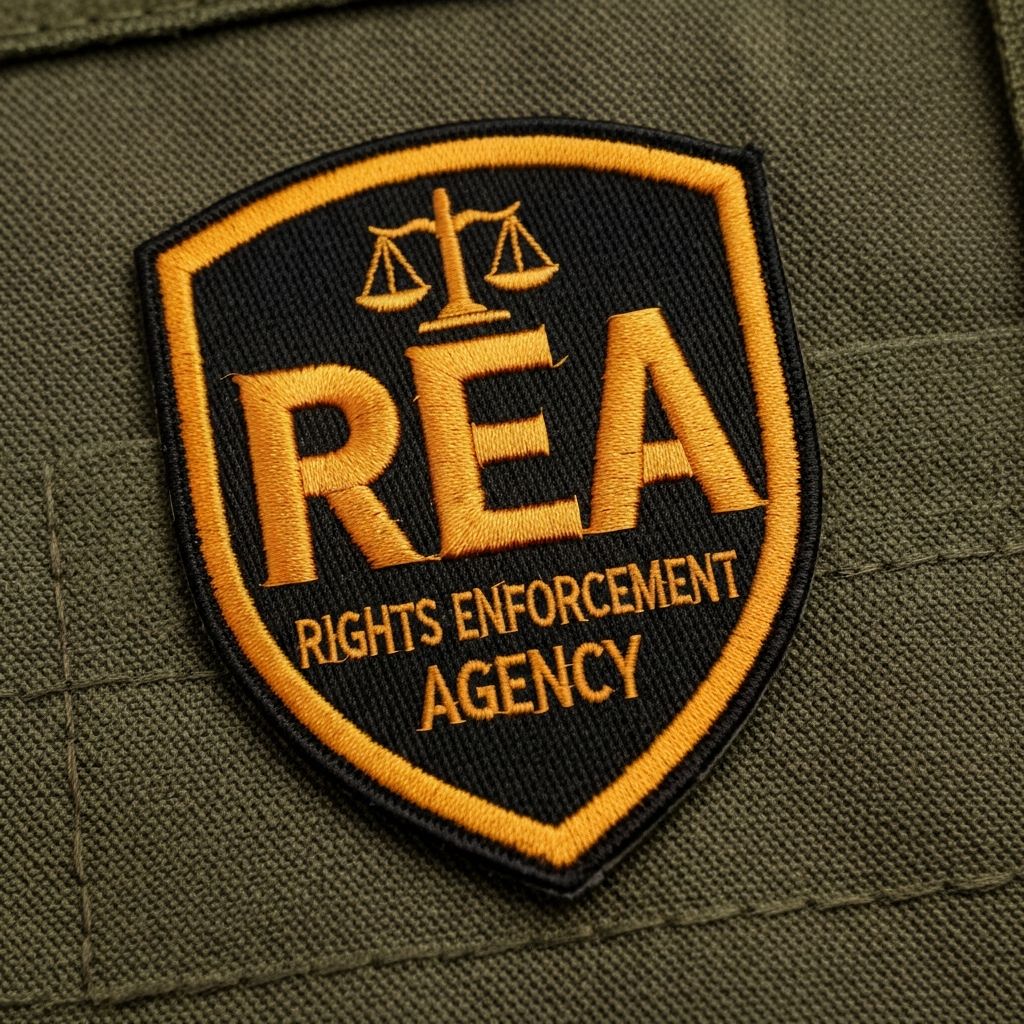
 REA Bureau
Dispatch: 'We Don't Want to Be Necessary' — An Anonymous Interview with Someone Who Claims REA Membership

After three weeks of encrypted back-and-forth through multiple channels, The Dead Drop secured a 45-minute voice-altered conversation with an individual claiming to be a member of what online observers have begun calling the Rights Enforcement Agency — or REA.
The Dead Drop cannot independently verify this person's membership or role. We present this interview in the interest of public understanding while noting that unverified claims should be treated with appropriate skepticism. The individual will be referred to as "the source."
The conversation was conducted over Whisper with voice alteration. The source initiated contact via our DeadDrop Vault three weeks ago.
THE DEAD DROP: Let's start with the obvious. What is the REA?
SOURCE: The Rights Enforcement Agency. Though "agency" is probably too formal a word. We're a network. Decentralized. Cells in most major metros and a lot of mid-size cities you wouldn't expect. Each cell is autonomous — they know their community, they know their problems, they decide their actions.
DD: How many members?
SOURCE: I genuinely don't know. That's by design. I know my cell. I know some people at the state coordination level. I know a few national contacts. The whole point is that no one person can compromise the whole network.
DD: That sounds like a terrorist organization.
SOURCE: [Long pause.] It sounds like any effective organization that operates in an environment where the people who are supposed to enforce the law are the ones breaking it. The ACLU has chapters. We have cells. The framing is a choice.
DD: What do you actually do?
SOURCE: It depends on the cell and the situation. Some of us do what you saw in Portland — show up, be visible, be a physical reminder that someone is watching. We call those "shield actions." They're completely legal. We stand there. We don't engage. We don't carry weapons at shield actions, ever.
DD: And the other kind?
SOURCE: We call them "lamp actions." As in, shining a light. Maricopa was a lamp action. Milwaukee was a lamp action. You find the information, you verify it seven ways to Sunday, and then you make sure the right people have it. Sometimes "the right people" is the victim. Sometimes it's the press. Sometimes it's the person who did the wrong thing, because you'd be amazed how quickly people correct course when they realize their secrets aren't secret anymore.
DD: Have you ever used violence?
SOURCE: No. And we won't. That's a line, not a guideline. Any cell that uses violence is out. Period. We're not a militia. We're not an insurrection. We're the accountability mechanism that's supposed to already exist but doesn't.
DD: How do you get your information?
SOURCE: I can't tell you that. But I'll say this — a lot of people in a lot of institutions are very tired of watching bad actors face no consequences. We don't have to break into anything. People come to us. They bring us things because they've exhausted every legitimate channel and nothing happened.
DD: You're describing whistleblower facilitation.
SOURCE: Among other things. Yes.
DD: What's the end goal?
SOURCE: Honestly? To not be necessary. We exist because the system fails. If the system worked — if internal affairs actually investigated, if prosecutors actually charged, if oversight boards actually had teeth — we'd have nothing to do. We'd love to have nothing to do.
DD: One last question. The amber vests. The bold "REA" lettering styled like FBI or DEA gear. That's a deliberate choice. Why?
SOURCE: [Slight laugh.] Because letters on a vest shouldn't only mean "step back, we have authority." Authority doesn't belong to any one institution. When people see FBI on a jacket, they understand: this is an agency, and it has jurisdiction. We wanted people — and especially the people we're watching — to understand the same thing. REA is three letters that mean: someone is paying attention, and we have the standing to be here. The amber is ours. The balance scales on the shoulder patch — that's the whole philosophy in one image. Justice is supposed to be balanced. When one side gets heavier — more power, less accountability — someone has to put weight on the other side. That's us.
DD: It could also be seen as impersonating federal agents.
SOURCE: We're not impersonating anyone. The FBI wears navy with yellow letters. DEA is black with white letters. ATF does olive with yellow. We wear olive with amber. Nobody's getting confused at a checkpoint. But if a dirty cop sees amber "REA" in a crowd and his stomach drops? Good. That's the point.
DD: Why now? Why has this started now?
SOURCE: [Another pause.] Because we're ready now. It took a long time to build something this careful. And honestly... because people are running out of options. When every legitimate avenue is closed, people don't just accept it. They find another way. We're trying to make sure that other way is thoughtful and disciplined rather than... the alternative.
DD: Thank you for your time.
SOURCE: Thank you for listening. Tell people to pay attention. Not to us — to what we're pointing at.
See Their Side
These are external sites operated by the groups themselves. PAR provides these links for context, not endorsement.